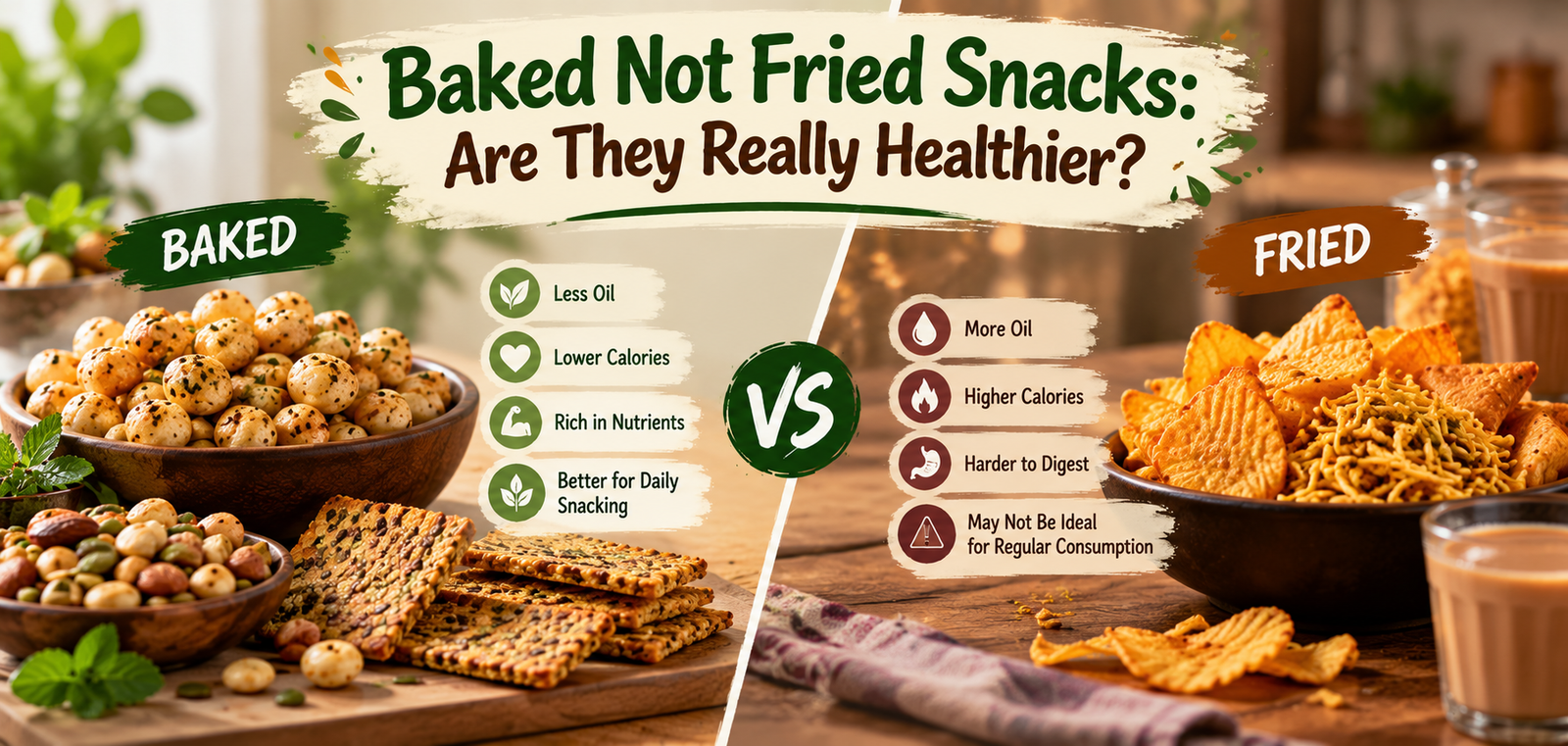
Baked not fried snacks sound like an easy upgrade when you want something crunchy without choosing a deep-fried option. And the cooking method does matter: baking can reduce the amount of oil used during cooking compared with deep frying. But “baked not fried” is only one part of the nutrition story. The ingredients, type and amount of fat, sodium, fibre, serving size and how often you eat the snack matter too.
This guide explains how to compare baked and fried snacks without relying on front-of-pack claims alone, with practical examples for Indian tea-time and everyday snacking.
Baked Not Fried Snacks: What Does the Claim Really Mean?
At the simplest level, “baked not fried” describes how a snack is cooked. Instead of being submerged in hot oil, the food is cooked using dry heat in an oven or similar process. That can mean less cooking oil is absorbed, depending on the recipe and manufacturing process.
However, baking does not automatically make every product low in fat, low in sodium or low in calories. Oil may still be added to the dough, coating or seasoning for texture and flavour. The base ingredients also matter: a baked snack made mostly from refined starches and plenty of added fat can have a very different nutrition profile from a baked snack made with whole grains, pulses, nuts or seeds.
That is why the most useful question is not simply “Is it baked?” but “What is in it, and what does the nutrition label say?”
Baked Snacks vs Fried Snacks: The Key Differences
Cooking method changes the way a snack develops texture and flavour, but it is not the only factor that determines its overall nutritional profile. Here is a practical comparison.
FactorBaked snacksDeep-fried snacksWhat to check Cooking methodDry heat, usually in an ovenFood is immersed in hot oilHow much oil is used in the full recipe Oil absorptionOften lower, but not alwaysCan be higher because food cooks in oilTotal fat per comparable amount CaloriesMay be lower if less fat is usedMay be higher if more oil is absorbedEnergy per 100 g or equivalent serving SodiumCan still be highCan still be highSodium on the nutrition panel IngredientsCan range from whole-grain to highly refinedCan range from whole-food to highly refinedIngredient list and order of ingredients Portion sizeStill mattersStill mattersServing size and number of servings per pack The World Health Organization recommends limiting saturated and trans fats and suggests cooking methods that reduce reliance on frying. It also notes that processed foods can contain undesirable fats regardless of how they are marketed, so the cooking method should not be treated as a complete health verdict.
5 Things to Check Before Buying Baked Snacks
A quick label check can tell you much more than a large “baked” badge on the front of the pack. When comparing two snacks, use the same basis—such as per 100 g—whenever possible so you are comparing like with like.
1. Read the ingredient list first
Ingredients are generally listed in descending order by weight. Look at the first few ingredients because they make up most of the product. Whole grains, pulses, nuts and seeds can add useful nutrients, while a product dominated by refined flour or starch may offer less fibre.
Also remember that “no maida” is one useful product attribute, not a guarantee that a snack is nutritionally ideal. The complete recipe still matters.
2. Compare total fat, saturated fat and trans fat
Baking may reduce oil absorbed during cooking, but added oil can still be part of the formulation. Compare the actual total fat and saturated fat values instead of assuming the baked product is automatically lower.
WHO recommends keeping industrially produced trans fat out of the diet and limiting saturated fat as part of an overall healthy eating pattern.
3. Check sodium, especially in savoury snacks
A snack can be baked and still contain a generous amount of salt or sodium. This is especially relevant for namkeen-style products, crackers, chips and strongly seasoned snacks. Comparing sodium between similar products can help you make a more informed choice.
4. Look for fibre and protein, not only calories
Calories are useful, but they are not the only number that matters. A snack with fibre and protein may feel more satisfying than one made mainly from refined starch. Whole grains, legumes, nuts and seeds are common ways snacks can provide more of these nutrients.
5. Pay attention to serving size
A nutrition panel may look impressive until you notice that the listed serving is much smaller than the amount you normally eat. Check the serving size and number of servings in the pack, then decide what a realistic portion looks like for you.
Are Baked Snacks Better for Everyday Tea-Time?
They can be a useful option, particularly if the alternative is a heavily fried snack and the baked version has a favourable ingredient and nutrition profile. But tea-time is also a good opportunity to build a more balanced snack rather than relying on one packaged food alone.
For example, you could pair a modest portion of a baked savoury snack with unsweetened tea and a protein- or fibre-rich side such as plain curd, roasted chana, nuts or fresh fruit, depending on your preferences and dietary needs.
If you enjoy Indian-style crunch, The Foods Life offers baked puri options designed for tea-time and on-the-go snacking. The Jeera Twist Puri, for example, is described as baked and made without maida. The important next step is still to use the nutrition panel and your portion size to decide how it fits into your overall diet.
What About “No Maida”, “Multigrain” and Other Front-of-Pack Claims?
These claims can be useful clues, but they should lead you to the back of the pack rather than end the decision. “No maida” tells you refined wheat flour is not used, but it does not tell you how much fibre, sodium, fat or total energy the product contains. “Multigrain” tells you more than one grain is present, but the nutrition panel and ingredient order show how meaningful that is in the actual recipe.
A simple rule is to treat the front label as the headline and the ingredient list plus nutrition panel as the full story.
How to Build a Smarter Snack Plate
Whether your snack is baked, roasted or occasionally fried, a few habits make everyday snacking more balanced.
- Choose a sensible portion: Pour the snack into a small bowl instead of eating directly from a large pack.
- Add something fresh: Pair crunchy snacks with fruit, cucumber, carrots or another fresh food you enjoy.
- Include protein when practical: Plain curd, roasted chana, nuts or a simple dip can make the snack more filling.
- Watch salty pairings: If the snack is already well-seasoned, avoid adding extra salty chutneys or condiments.
- Keep variety in the week: Rotate packaged snacks with fruit, nuts, sprouts, homemade chaat and other minimally processed foods.
For another practical snack comparison, read our guide to khakhra vs potato chips.
FAQs About Baked Not Fried Snacks
Are baked snacks always healthier than fried snacks?
No. Baking can reduce the oil used during cooking, but the final nutrition profile depends on the full recipe. Compare calories, total fat, saturated fat, sodium, fibre, protein, ingredients and serving size.
Do baked snacks contain zero oil?
Not necessarily. Many baked snacks still use oil in the dough, seasoning or coating. Check the ingredient list and nutrition panel if oil content matters to you.
Are baked snacks good for weight management?
They can fit into a weight-management eating pattern when portion size and total calorie intake are appropriate, but “baked” alone does not make a food low-calorie. A balanced overall diet matters more than one cooking claim.
What should I check on a packaged snack label?
Start with the ingredient list, then compare energy, total fat, saturated fat, trans fat, sodium, fibre, protein, serving size and servings per pack. When comparing products, use the same reference amount wherever possible.
Is a no-maida baked snack automatically healthy?
No. “No maida” can be a useful feature, but you should still check what flours or starches are used instead and review the rest of the nutrition panel.
Can baked puri be a tea-time snack?
Yes. A baked puri can be part of tea-time in a sensible portion. Pairing it with a fresh or protein-rich food can make the snack more balanced.
How often can I eat packaged baked snacks?
There is no single frequency that suits everyone. Your overall diet, portion size, nutritional needs and health goals matter. Use packaged snacks as one option within a varied eating pattern rather than making them the only type of snack you rely on.
Conclusion: Baked Is a Useful Clue, Not the Whole Answer
Baking can be a practical way to reduce reliance on deep frying, and it can produce a lighter-feeling crunchy snack. But the smartest choice comes from looking beyond the cooking method. Check the ingredients, compare the nutrition panel, keep an eye on sodium and fat quality, and choose a portion that fits your day.
If you want to explore a crunchy Indian option, browse The Foods Life’s baked puri range, including Jeera Twist Puri and Masala Twist Puri, and compare the product information to find the option that best fits your preferences.
Sources: World Health Organization healthy-diet and trans-fat guidance; Food Safety and Standards Authority of India nutrition-labelling requirements; American Heart Association healthy cooking guidance; The Foods Life product information.




 +91 63528 07509
 sales@thefoodslife.com
 225, Orchid Plaza, Sama-Savli Rd, behind McDonald's, Vemali, Vadodara, Gujarat 390008